
Building Stronger Foundations
See how our platform combines digital screening, real-time insights, and evidence-based support to help providers detect risks earlier, engage patients continuously, and deliver personalized care that improves outcomes.
Continuum of physical and behavioral health care integration


Coordinated care
In this first level of integration, behavioral health providers and primary care providers work within physically separate facilities and have separate health record systems.
Providers communicate rarely about cases; if communication occurs, it is usually based on a particular need for specific information about a mutual patient.
Colocated care
Behavioral health providers and primary care providers deliver care in the same physical location or practice. Patient care is often still siloed to areas of expertise.
Due to the proximity of behavioral health and primary care providers, there may be occasional meetings between providers to discuss mutual patients.
Integrated care
Behavioral health providers and primary care providers function as a team, working together in the same physical space to design and implement a patient care plan.
Providers understand the different roles team members play and structure the delivery of care to better achieve patient goals.
Providers and patients view the clinical operation as a single system.

Integrated behavioral health care is necessary in primary care because it recognizes the vital conncection between mental and physical well-being. By combining behavioral health care services with primary care, individuals receive holistic, accessible, and timely care. Integration allows for early intervention, reducing the impact of mental health conditions. Coordinated treatment plans improve outcomes and patient satisfaction. Integration reduces the stigma often associated with behavioral health by normalizing mental health conversations and encouraging patients to seek help. It optimizes resource utilization, resulting in much more cost-effective healthcare.
Overall, integrated behavioral health care in primary care ensures comprehensive, patient-centered support that enhances the overall health and well-being of patients.
Mobile app for patient engagement
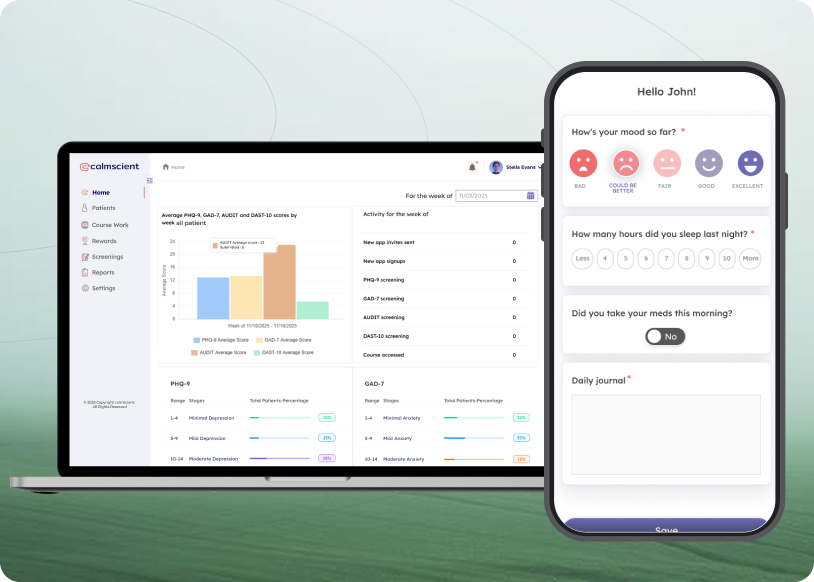
A mobile app (iOS and Android) providing patients with education on mental health issues, self-help activities geared toward improving mental health, and regular mental health screening.

Provider admin portal & Risk monitoring
Seamless EHR & Practice management integration
Seamless integration between the Calmscient mobile app, Admin Portal and the practice’s Electronic Health Record (EHR) and Practice Management (PM) system. This allows providers to access Calmscient data directly from the patient’s clinical record.